


UKG Wallet
UKG, Inc.
Getting access to earned wages before the usual payday can be genuinely useful, especially when an unexpected bill arrives at an awkward time. That is the basic reason UKG Wallet caught my attention. It is a free business app from UKG, Inc., designed around access to wages you have already earned rather than acting like a general banking replacement. In my first week, the appeal was easy to understand: it puts a work-related money task in a separate place, keeps the purpose clear, and can be helpful when timing matters more than long-term financial planning.
That usefulness comes with an important condition. This is not an app I would recommend simply because everyone should have another finance tool on their phone. Its value depends heavily on whether your employer’s payroll setup supports the experience and whether you actually benefit from viewing or accessing earned pay between regular paydays. For the right employee, it can become a practical part of a monthly routine. For someone looking for investing, detailed budgeting, bill negotiation, or a full checking account, it is the wrong category entirely.
What UKG Wallet feels like after the first week
The first impression is focused rather than sprawling. UKG Wallet sits in the business category, and that identity matters: I approached it as an extension of workplace pay administration, not as a replacement for my everyday bank. The store identifies it as suitable for Everyone, and the app is free to install. Those details make trying it relatively low-risk, although the real usefulness still depends on the connection between the app, your employer, and your payroll information.
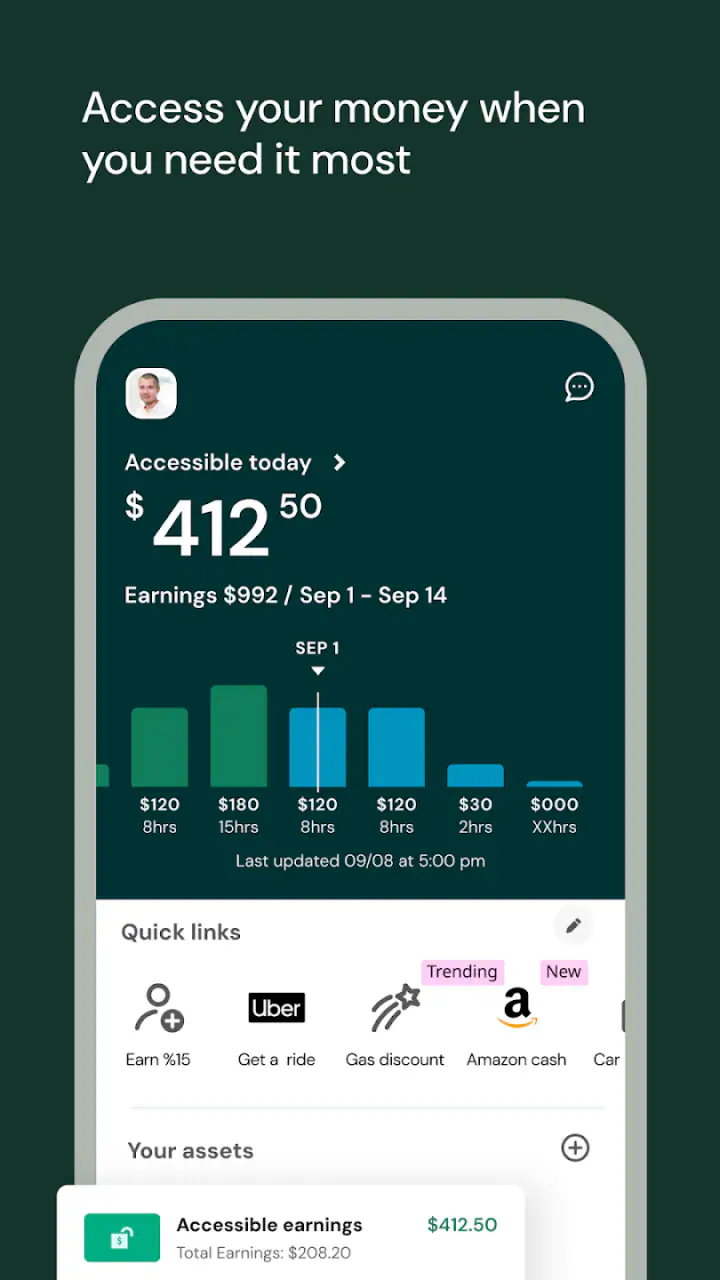
During the first few days, the strongest benefit is clarity of purpose. Instead of opening a broad personal-finance app and sorting through accounts, cards, spending categories, and promotions, I can think about one question: what earned wages are available to me and how might that help before payday? That narrow focus can feel refreshing. It also prevents the app from becoming another dashboard that demands attention without solving a specific problem.
A realistic example is a mid-month car repair. I might normally put the expense on a credit card, delay the repair, or ask someone close to me for help. If UKG Wallet shows that wages have already been earned and makes them accessible through the supported workplace arrangement, the app can offer another route. The important distinction is that this is not money appearing from nowhere. It is an early-access decision involving pay that would otherwise arrive later, so I would use it as a timing tool rather than treating it as extra income.
Related News

Why WhatsApp Messenger Still Makes Everyday Communication Feel Easy

Jurassic World: The Game Is the Better Dino Tycoon for Strategic Players

Threads in Real Life: Who Should Join, Lurk, or Leave

How SHEIN Turned Shopping Into an Endless Content Feed

How to Make Fortnite Feel Smarter on Mobile

Should You Switch to Microsoft Outlook on Mobile?
That distinction is one of the most useful habits to establish immediately. I would not open the app only when I am already stressed and need money urgently. I would first learn where the available-wage information appears, understand the steps involved in accessing it, and decide what kind of expense would justify using it. A few minutes of preparation can prevent a rushed choice later.
UKG Wallet has a 4.5 average from around 12 thousand ratings, with roughly 1.9 thousand written reviews. That level of response suggests the concept resonates with many users, but ratings should not replace checking whether the app fits your own payroll situation. A smooth experience for one employee may not translate directly to another if their employer configuration, pay cycle, or workplace rules differ.
The app is strongest when the need is temporary
I see the clearest first-week value in short-lived cash-flow gaps. A utility bill, school expense, prescription, or necessary household purchase can create pressure even when the next paycheck is predictable. In those cases, early access may be more useful than opening a new line of credit, assuming the available option and its terms make sense for the user.
Gallery
It is less convincing as a way to permanently solve an income shortfall. If I regularly need early access to cover ordinary expenses, the app may make the timing problem feel manageable while leaving the underlying budget problem untouched. That is not a criticism of the software itself; it is a reminder that convenience can hide repetition. The more often I rely on an advance, the more carefully I need to examine whether the following pay period becomes tighter.
Another practical point is that the app should not be judged like a normal banking app. Someone comparing it with a checking account may be disappointed because the purpose is narrower. Someone comparing it with a generic budgeting app may find fewer reasons to open it every day. Its first-week appeal comes from solving a specific workplace-pay problem, not from offering an entire financial ecosystem.
How it compares with usual alternatives
The usual alternatives each solve a different part of the problem. A bank account is better for storing money, making routine payments, and managing a full financial relationship. A budgeting app is better for tracking spending patterns and setting longer-term limits. A credit card may provide immediate purchasing power, but it can turn a short-term timing issue into revolving debt. Asking an employer about payroll timing may be simpler if the need is recurring and administrative rather than urgent.
UKG Wallet is most attractive in the space between those choices: I already earned the money, but the normal payday has not arrived. That makes it more targeted than a bank and potentially less expensive or less risky than borrowing, depending on the specific circumstances. It does not automatically beat every alternative. If I need a complete view of my finances, I would use a banking or budgeting tool alongside it. If I need a long-term solution, I would focus on income, expenses, and payroll arrangements rather than relying on early access alone.
Whether it keeps earning a place month after month
The first-week novelty fades quickly because this is not an app built around entertainment or constant discovery. Its lasting value depends on whether the earned-wage workflow repeatedly helps with real timing problems. I would not expect to open it every day. In fact, daily checking could encourage me to think of available wages as spendable money before I have considered the rest of the month.
For me, the healthier monthly pattern would be occasional and deliberate. I might check it around a known period when bills are concentrated, confirm what is available, and decide whether using the service is genuinely better than waiting. That turns the app into a financial safety valve rather than a routine spending trigger. The value is not measured by how often I use it, but by whether it gives me a reasonable option when the calendar and my bills do not line up.
One non-obvious advantage of this approach is that the app can make payroll timing more visible. Many people know their gross salary and regular payday but do not think carefully about how much of the current pay period has already been worked. Seeing that distinction can improve decision-making, even when I choose not to access the money. I can use the information as a pause: the amount may be earned, but it still belongs to the wider plan for rent, food, transport, and upcoming obligations.
I would also keep a simple personal record of any early access. Not because the app necessarily requires one, but because memory is poor when several transactions happen close together. Writing down the amount and the reason helps me see whether the tool is handling occasional emergencies or becoming part of every pay cycle. That small habit is one of the best ways to preserve the app’s usefulness without letting it quietly reshape my budget.
The app has reached over 100 thousand installs, which indicates that it is not an obscure experiment with no audience. Its current version is 1.0.25, and the release date shown for it is December 21, 2021. I would still treat those store details as context rather than a promise that every workplace experience will be identical. The important test is whether the current payroll connection remains accurate and whether the workflow is dependable when I actually need it.
Who benefits most from the recurring value
UKG Wallet makes the most sense for employees whose pay is predictable but whose expenses are not. A household with an irregular repair, a worker facing a short gap before payday, or someone trying to avoid a high-cost borrowing option may find a useful role for it. The strongest candidates are people who can repay the timing difference naturally through the next pay cycle and who are willing to treat access as a calculated choice.
It may also help someone who wants a clearer separation between workplace pay tools and personal banking. Keeping the earned-wage question in a dedicated app can be less distracting than managing it inside a large financial platform. That separation is useful when I want to check one specific matter without being pulled into unrelated financial products or promotional features.
On the other hand, I would skip it if my employer does not support the relevant experience, if my income is already too tight to absorb earlier access, or if I want a complete money-management system. It is also not the right answer for someone who needs investment guidance, credit building, detailed category tracking, or a replacement for a bank account. Installing it will not fix a budget that is structurally short every month.
The maintenance burden is low, but the financial discipline is not
From a phone-maintenance perspective, the app is likely to be easier to live with than a tool that expects constant manual categorization. I do not need to turn it into a daily project. The more important maintenance happens outside the interface: keeping my payroll details and personal expectations aligned, reviewing whether I have used early access too often, and making sure I do not confuse earned wages with additional income.
That is where the real friction appears. An app can make access feel simple, but the consequences still belong to my next payday. If I use it for a nonessential purchase, I reduce the amount arriving later. If I use it for an emergency, the trade-off may be worthwhile. The decision requires more judgment than the clean interface or focused purpose might suggest.
I would also build a backup plan before depending on it. If a bill is due on a specific day, I would not assume an app-based option alone will remove every timing risk. I would check the available balance early, allow room for processing or workplace-related conditions, and keep another payment method in mind. This is a practical trade-off: the app may improve flexibility, but it should not become the only bridge between my paycheck and an essential obligation.
The minimum operating-system requirement is version 10, so people using older devices may need to update their phone or use another method. For most current Android or iOS users, that requirement is unlikely to be a major obstacle, but it is still worth checking before planning around the app. A financial tool is most useful when it is available before the urgent moment, not when a compatibility issue appears at the last second.
What can cause fatigue over time
The biggest source of fatigue is psychological rather than technical: repeatedly seeing earned wages available can make it tempting to spend before the normal pay date. Even responsible users can start treating the app like a small reserve that refreshes with each work period. I would resist that mindset by opening it with a purpose, not from boredom or curiosity.
Another source of frustration is dependence on the workplace arrangement. Since this is a business-focused product tied to earned wages, the experience is not entirely under my control as an individual user. Payroll timing, employer participation, and the way work information is handled can matter as much as the app screen itself. That means I would not judge the product solely on how polished it feels during setup; I would judge whether it remains useful in the exact employment context where I need it.
There is also a risk of using the app as a substitute for communication. If I am repeatedly struggling before payday, the better solution might be discussing pay scheduling with an employer, revising recurring bills, or building a small emergency reserve. UKG Wallet can help with a gap, but it should not stop me from addressing the reason the gap keeps appearing.
For users who prefer everything inside one financial app, the separate role may feel inconvenient. I may need to move from the wallet experience to my bank, budgeting tool, or bill-payment service to complete the rest of the task. That is not necessarily a flaw; it reflects the product’s limited scope. Still, people who value a single unified dashboard should know that this app is better viewed as one focused instrument than as a complete financial command center.
My long-term verdict
After the novelty fades, I think UKG Wallet can earn lasting space on the phone for the right employee, but only as an occasional, intentional tool. Its recurring value comes from improving cash-flow timing, not from adding more financial activity. I like that distinction because it gives the app a clear job. When the job is needed, the benefit can be meaningful; when it is not needed, there is little reason to force it into a daily routine.
I would recommend it to someone whose employer supports the experience and who wants a focused way to consider access to earned wages before payday. I would explain that the safest use is planned, limited, and connected to a real expense. I would also encourage that person to compare the choice with waiting, using existing savings, adjusting a bill date, or selecting another borrowing option that they fully understand.
I would not recommend it as a cure for chronic overspending or as a replacement for banking and budgeting tools. Its free price makes experimentation easier, and the Everyone age rating broadens its general accessibility, but neither detail changes the need for personal discipline. The app can improve timing; it cannot create a healthier budget by itself.
My final view is positive but measured. UKG Wallet is more useful than a generic finance app when the specific problem is earned pay arriving later than the expense. Its focused design gives it a practical role, and its audience size shows that the idea has found real interest. The lasting test, however, is whether I can use it without turning every pay period into an early withdrawal cycle. If I can keep that boundary, it deserves a place as a quiet backup. If I cannot, waiting for payday or choosing a broader financial solution is probably better.
FAQs for UKG Wallet
What is UKG Wallet, and what does it do?
UKG Wallet is a mobile financial wellness feature connected to participating UKG workforce-management and payroll systems. It may allow eligible employees to view earned wages, access available pay before the regular payday, review transactions, and manage related account settings from a phone. The exact features depend on the employer’s UKG configuration, payroll process, location, and eligibility rules.
Who can use UKG Wallet, and how do I sign up?
UKG Wallet is generally intended for employees whose employer offers the service through a supported UKG platform. You normally need valid employee credentials, an eligible payroll account, and identity or account verification during setup. Downloading the app alone does not guarantee access. If your employer has not enabled UKG Wallet, or your employment details are not eligible, you may be unable to register or use wage-access features.
Can UKG Wallet let me access my pay before payday?
In supported workplaces, UKG Wallet may provide access to a portion of wages already earned during the current pay period, subject to employer policies and applicable limits. This is not necessarily the same as receiving your full paycheck early. Available amounts can change as hours, attendance, payroll data, deductions, and corrections are processed. Review the displayed fees, limits, and delivery timing before confirming a transfer.
Are there fees for using UKG Wallet?
Some UKG Wallet services may be free, while optional features or particular delivery methods could involve fees, depending on the program offered by your employer and your region. Before completing a transaction, check the confirmation screen for any charges, transfer limits, or processing times. Because pricing and availability can change, the in-app information and your employer’s official guidance should be treated as the most accurate sources.
Is UKG Wallet safe, and what should I do if I have a problem?
UKG Wallet is designed to handle employee and payment information using account security measures, but users should still protect their login details, enable device security, and avoid signing in through suspicious links. Check permissions and keep the app updated. For missing wages, incorrect balances, failed transfers, login issues, or questions about eligibility, contact your employer’s payroll or HR team and use the app’s official support options.
Pros
- Centralizes payroll
- benefits
- and workplace information in one app.
- Mobile access makes checking pay details convenient while away from a computer.
- Useful notifications can remind users about important HR tasks and updates.
- Supports employee self-service
- reducing the need to contact HR for routine requests.
- A familiar dashboard helps users quickly find commonly used workplace tools.
Cons
- Available features depend heavily on the employer’s UKG configuration.
- Some actions may redirect users to web pages rather than stay fully in-app.
- Login problems can be difficult to resolve without help from the employer’s HR team.
- Sensitive payroll and personal data require careful attention to device security.
- Updates or maintenance may temporarily affect access to workplace information.


